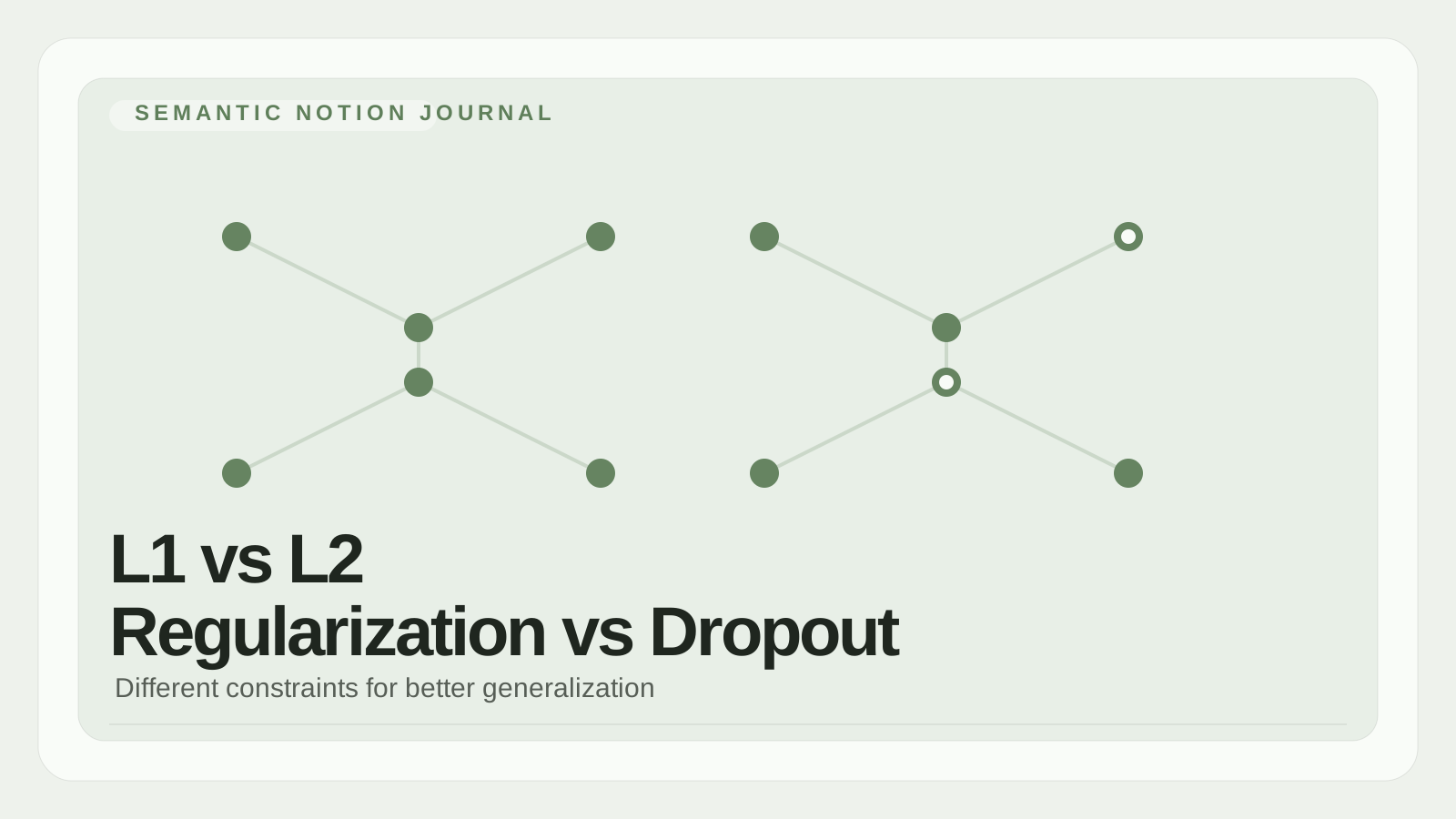
L1 regularization, L2 regularization, and dropout are all techniques used to reduce overfitting, but they do not do the same thing. L1 and L2 regularization penalize model weights directly, while dropout randomly removes parts of the network during training so the model cannot rely too heavily on any one path.
The shared goal is better generalization. The mechanism is where the difference lies.
Why Regularization Exists at All
A sufficiently flexible model can fit training data very well. The problem is that training accuracy is not the real objective. The real objective is performance on new data.
Regularization exists because models often need pressure not to become too brittle or too specialized to the training sample.
That is why regularization sits naturally beside bias vs variance tradeoff and overfitting vs underfitting vs generalization.
L1 and L2 Are Weight Penalties
Both L1 and L2 regularization modify the objective function by adding a penalty based on the model's weights.
The idea is simple:
- fitting the data is good
- using unnecessarily large or unstable weights can be risky
- so training should balance data fit against weight complexity
This means the model is not only rewarded for reducing prediction error. It is also encouraged to keep parameters under control.
What L1 Regularization Does
L1 regularization adds a penalty proportional to the absolute values of the weights.
Its most famous effect is sparsity.
Because the penalty does not grow quadratically, L1 often encourages some weights to shrink all the way toward zero. That can make the resulting model more selective about which features it relies on.
This is why L1 is often associated with:
- sparse solutions
- feature selection behavior
- models where interpretability of active features matters
It does not magically choose the truth, but it can encourage a cleaner and more selective parameter pattern.
What L2 Regularization Does
L2 regularization adds a penalty proportional to the squared values of the weights.
Instead of forcing many weights exactly to zero, it tends to shrink weights smoothly. Large weights become especially expensive, so the model is encouraged to spread influence more gently.
This often leads to:
- more stable parameter values
- less reliance on extreme coefficients
- smoother generalization behavior
L2 is one of the most common defaults because it is simple, broadly useful, and works naturally with gradient-based optimization.
The Practical Difference Between L1 and L2
The shortest distinction is:
- L1 often encourages sparsity
- L2 often encourages small but distributed weights
That difference matters when thinking about model behavior.
If you want the model to become more selective about features, L1 may be attractive.
If you want to discourage large weights while keeping many features softly active, L2 is often the more natural fit.
Dropout Is a Different Kind of Constraint
Dropout is not a penalty on weight size. It changes the training process itself.
During training, dropout randomly disables a subset of units or activations. That means the network cannot depend too heavily on one particular path through the model.
The result is that the network is pushed to learn more distributed and robust representations.
You can think of dropout as a way of preventing fragile co-dependencies from becoming too strong.
Why Dropout Helps
If a model always has access to the exact same internal pathways during training, it may learn brittle patterns that depend too much on specific neurons or interactions.
Dropout disrupts that.
Because some units are randomly missing during training:
- the model cannot rely on one narrow route
- internal representations often become more redundant and robust
- overfitting pressure can decrease
This is why dropout became especially common in deep learning, where large networks can otherwise memorize aggressively.
L1, L2, and Dropout Are Not Interchangeable
They all fight overfitting, but they intervene in different places.
| Method | Main action | Typical effect |
|---|---|---|
| L1 | Penalizes absolute weight magnitude | Encourages sparsity |
| L2 | Penalizes squared weight magnitude | Shrinks weights smoothly |
| Dropout | Randomly removes units during training | Encourages robustness and reduces co-adaptation |
This is the important comparison to remember. Similar goal, different mechanism.
Which One Should You Use?
There is no universal winner.
Use depends on the model, the data, and the failure mode you are trying to control.
L1 can make sense when:
- sparse feature usage is desirable
- feature selection pressure is helpful
- simpler linear or generalized linear settings matter
L2 often makes sense when:
- you want a strong default stabilizer
- the model benefits from smooth weight shrinkage
- you do not specifically need sparsity
Dropout often makes sense when:
- you are training deep neural networks
- the network is large enough to overfit
- you want to reduce brittle internal dependencies
Regularization Usually Trades a Little Bias for Better Generalization
This is the heart of the idea.
Regularization may slightly reduce training performance because it constrains what the model can do. But that small increase in bias can be worth it if it reduces variance enough to improve validation and test performance.
That is why regularization should be judged by generalization, not by training loss alone.
Why This Matters for Modern ML
In real systems, you often combine methods rather than choosing exactly one forever.
A training pipeline may include:
- weight decay or L2-style penalties
- dropout in selected layers
- early stopping
- data augmentation
The right question is not "Which regularizer is best in the abstract?"
The better question is:
"Which constraint helps this model generalize more reliably on this task?"
From Generalization Theory to Product Work
Regularization choices become practical when teams see a model perform well in training and then behave unreliably in production or on genuinely new data. The issue is often not that the model needs more capacity. It is that the model has learned unstable shortcuts.
Understanding the difference between L1, L2, and dropout gives clearer intuition about how to stabilize training, reduce overfitting, and choose a model path that generalizes well enough for real use.
If your team is turning that model work into a production feature, QuirkyBit's guide on how to build an AI feature into an existing product covers the broader implementation layer around evaluation, rollout, and workflow fit.
Common Misunderstandings
Is dropout the same as removing features?
No. Dropout removes internal units or activations during training, not input features in a literal feature-selection sense.
Does L1 always make a model better?
No. Sparsity can help in some settings and hurt in others.
Is L2 only for linear models?
No. It is widely used across neural networks and many other differentiable models.
FAQ
What is the main difference between L1 and L2 regularization?
L1 tends to push some weights toward zero, while L2 tends to shrink weights more smoothly without forcing as much sparsity.
How is dropout different from L1 and L2?
Dropout changes the training process by randomly removing units, whereas L1 and L2 add penalties to the objective function.
Which regularization method is best?
There is no universal best method. The right choice depends on the model, the data, and the kind of overfitting you are trying to control.
Why can regularization improve performance if it adds constraints?
Because slightly constraining the model can reduce overfitting enough to improve performance on unseen data.