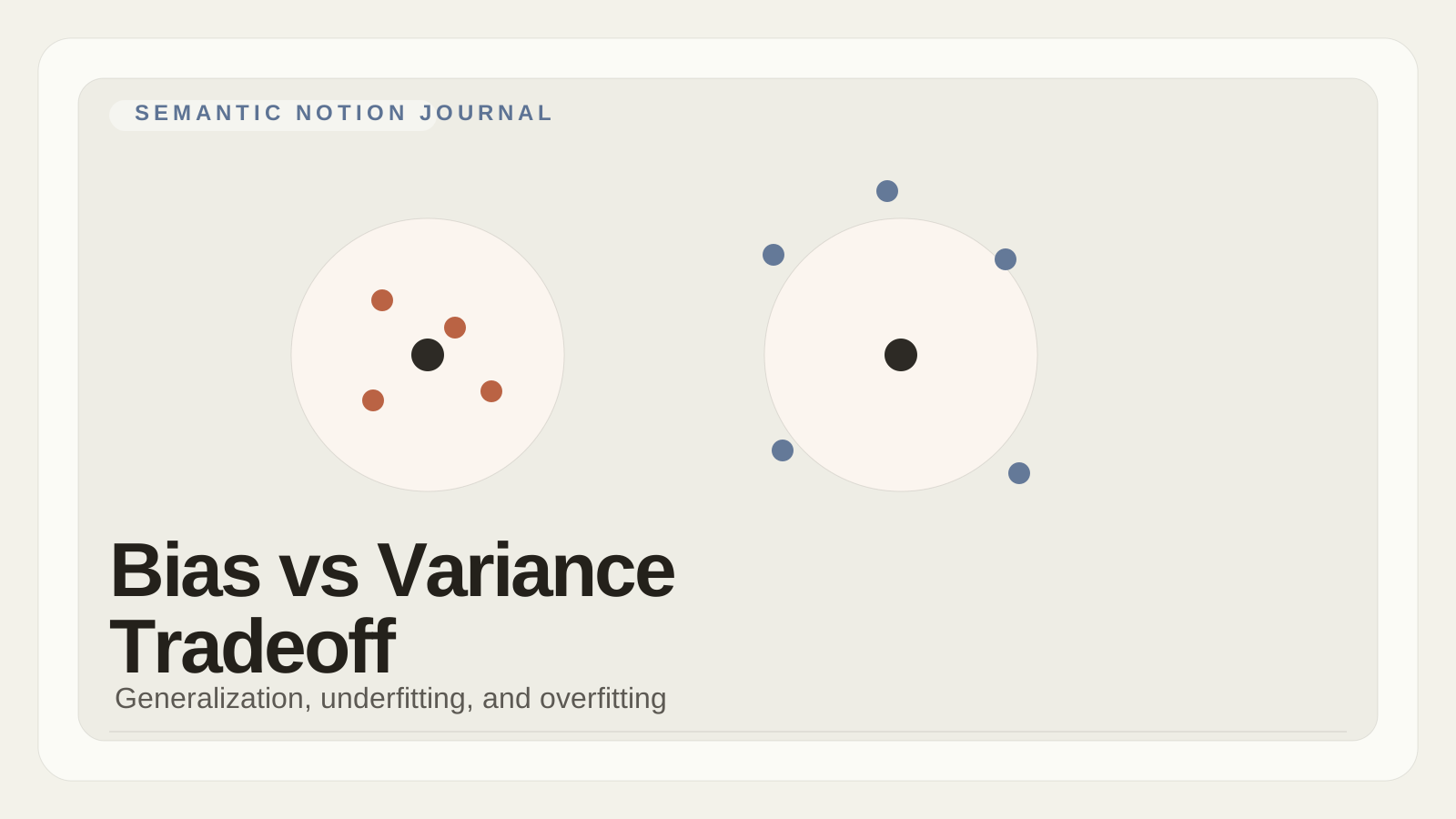
The bias-variance tradeoff describes two different ways a model can generalize poorly. High bias means the model is too rigid and systematically misses real structure in the data. High variance means the model is too sensitive to the particular training sample and learns unstable patterns that do not hold up well on new data.
This idea matters because good machine learning is not about memorizing the training set. It is about learning patterns that survive contact with unseen data.
Bias and Variance Are Different Failure Modes
It helps to start with the separation clearly.
Bias is about systematic error.
If the model is too simple or too constrained, it may fail to capture important relationships. It keeps making similar mistakes because its representation of the problem is too limited.
Variance is about instability.
If the model is too flexible, small changes in the training data can lead to noticeably different learned behavior. The model adapts too aggressively to the specifics of the sample rather than the deeper signal.
Both are bad, but in different ways.
High Bias Looks Like Underfitting
When bias is high, the model tends to underfit.
That often means:
- poor training performance
- poor validation performance
- a model that is too simple for the structure in the data
Imagine trying to fit a straight line to a pattern that is clearly curved. No matter how carefully you train, the model class itself may be too limited to represent what is happening.
That is the essence of high bias: the model misses real structure because it cannot express it well.
High Variance Looks Like Overfitting
When variance is high, the model may perform very well on training data but degrade on validation or test data.
This is closely related to overfitting vs underfitting vs generalization.
The model is not failing because it learned too little. It is failing because it learned too much of the wrong kind of detail.
That often looks like:
- excellent training fit
- weak generalization
- sensitivity to noise, outliers, or sample quirks
High variance models are often powerful but fragile.
Why Model Flexibility Matters
One major driver of the tradeoff is model flexibility.
As a model becomes more expressive:
- bias often decreases because the model can represent richer patterns
- variance often increases because the model can also fit accidental noise
This is why stronger models are not automatically better. More flexibility gives you more power, but also more ways to go wrong.
The challenge is not maximizing complexity. It is finding enough flexibility to capture signal without becoming unstable.
Data Size Changes the Story
Bias and variance do not depend only on the model. They also depend on the data.
With more data:
- variance can often be reduced because the model has a broader basis for learning stable patterns
- flexible models become easier to justify
With limited or noisy data:
- variance problems become more severe
- simpler or more strongly regularized models may generalize better
So the same architecture may behave very differently depending on sample size and data quality.
Noise Matters Too
If the data contains substantial randomness, ambiguity, or label noise, there is a limit to what any model can learn.
That matters because high-capacity models may start fitting the noise instead of the signal. In those situations, more flexibility can stop helping sooner than people expect.
This is why good generalization is always partly a data problem, not just a model-selection problem.
The Tradeoff Is Not a Formal Law of Nature
People sometimes talk about the bias-variance tradeoff as if it were a single curve you can always optimize cleanly.
The reality is messier.
Modern machine learning often includes:
- deep models with huge capacity
- large datasets
- explicit regularization
- data augmentation
- early stopping
- optimization effects that change practical behavior
So the bias-variance framing is still useful, but it is a conceptual guide, not a complete theory of all modern ML behavior.
It remains valuable because it helps you diagnose what kind of mistake you are dealing with.
How Regularization Enters the Picture
Regularization is one of the main tools for controlling variance.
Methods such as weight penalties, dropout, early stopping, and data augmentation all try in different ways to keep the model from fitting unstable details too aggressively.
That is why the bias-variance discussion naturally connects to L1 vs L2 regularization vs dropout.
Regularization often increases bias slightly while reducing variance enough to improve overall generalization.
A Simple Intuition
If a model says roughly the same wrong thing on many different samples, you are likely dealing with bias.
If a model says very different things depending on small changes in the sample, you are likely dealing with variance.
That simple mental test is not mathematically complete, but it is often useful in practice.
Why This Matters in Real ML Work
The bias-variance tradeoff shows up when deciding:
- how complex the model should be
- how much regularization to use
- whether more data is likely to help
- whether the model is fundamentally too weak or just too unstable
It also shapes how you interpret learning curves and validation gaps.
If training and validation are both poor, bias may be the issue.
If training is strong and validation is weak, variance becomes the more obvious suspect.
Why This Matters in Product Systems
This tradeoff becomes practical when teams are deciding whether poor model behavior comes from weak representation, too little data, too much variance, or evaluation that is hiding the real failure mode.
In production settings, bias-versus-variance questions show up in feature design, model selection, regularization choices, and the decision to keep iterating on a model versus changing the workflow around it.
If your team is trying to turn model experimentation into a usable AI feature, QuirkyBit's AI consulting service is focused on connecting model behavior, data reality, and product delivery decisions.
Common Misunderstandings
Is low bias always good?
No. A model with very low bias can still generalize badly if its variance is too high.
Does high variance mean the model is bad?
Not necessarily. Many powerful models have high variance unless they are paired with enough data and regularization.
Has deep learning made the bias-variance tradeoff irrelevant?
No. Deep learning made the practical picture more complex, but the distinction between rigid underfitting and unstable overfitting is still useful.
FAQ
What is bias in machine learning?
Bias is systematic error caused by a model being too limited or too rigid to capture the real structure in the data.
What is variance in machine learning?
Variance is instability caused by a model being too sensitive to the specific training sample.
How do bias and variance relate to underfitting and overfitting?
High bias is commonly associated with underfitting, while high variance is commonly associated with overfitting.
Why is the bias-variance tradeoff important?
Because strong performance depends on learning real signal without becoming either too rigid or too unstable.