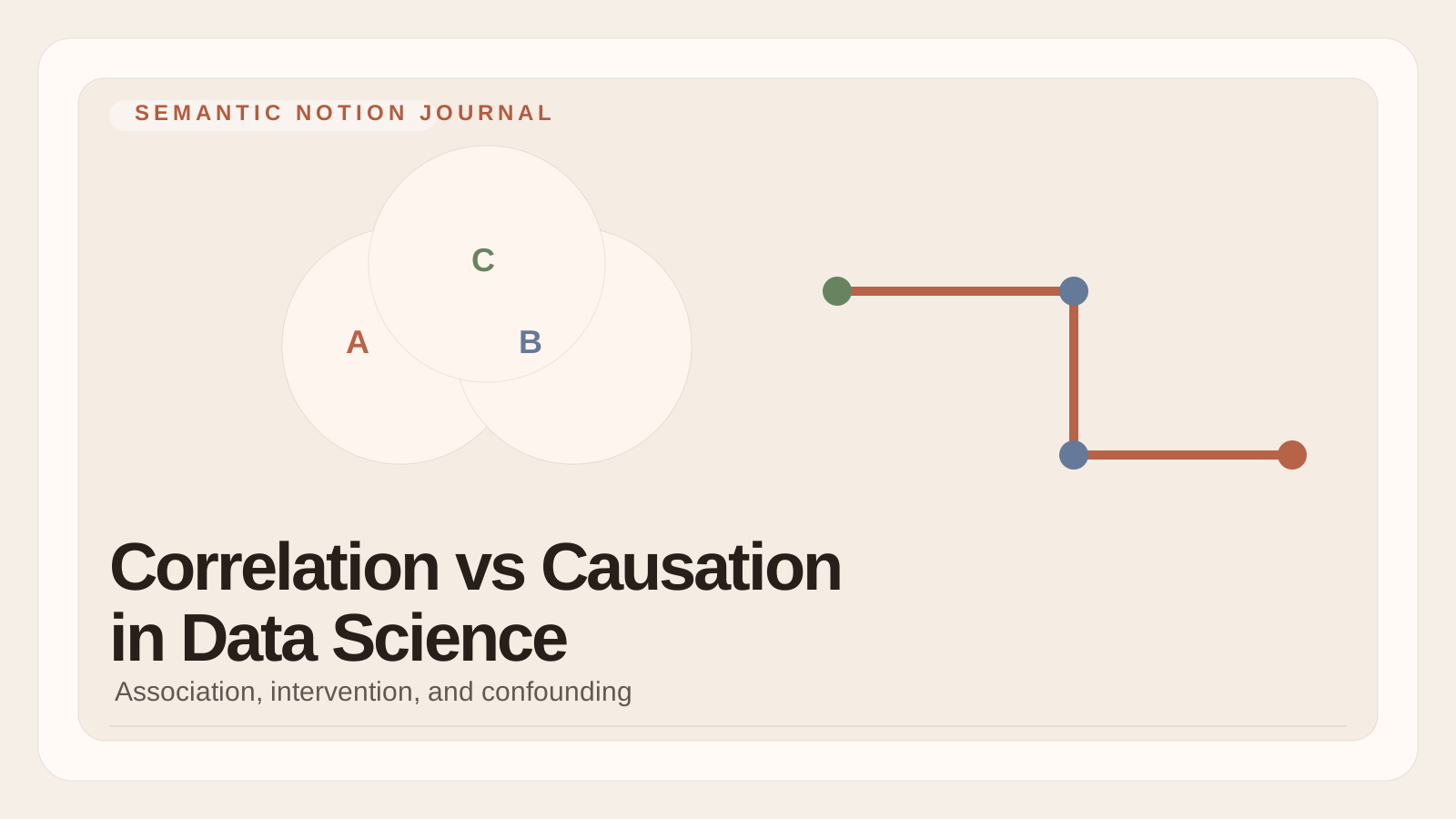
Correlation means two variables move together in some patterned way. Causation means changing one variable actually helps produce a change in the other. Those are not the same claim, and confusing them is one of the fastest ways to overstate what data can tell you.
In data science, the mistake is not only philosophical. It affects how people interpret models, design interventions, and justify decisions.
Correlation Is About Association
If two variables tend to rise and fall together, or differ in a patterned way, they are correlated.
That can be useful. Correlation can help with:
- prediction
- feature discovery
- exploratory analysis
- signal detection
If users who search for one topic also tend to buy a certain product, that pattern may be operationally useful even if you do not know the causal mechanism.
So correlation is not weak or meaningless. It is simply a different kind of statement than causation.
Causation Is a Stronger Claim
Causation says more than "these variables move together."
It says something closer to:
"If we change this variable, the other one will change because of that intervention."
That is a much stronger assertion.
It is the difference between:
- noticing that two things co-occur
- claiming that one actually produces the other
Once you make a causal claim, you are no longer just describing data. You are describing how the world works.
Why Confounding Causes Trouble
The biggest practical problem is confounding.
A confounder is a third factor that influences both variables, creating the appearance of a direct relationship even when the apparent cause is not the true driver.
This is why naive pattern-reading is dangerous.
Two variables can be strongly correlated because:
- one causes the other
- the other causes the first
- both are driven by a third variable
- the relationship is partly accidental
Without careful design or strong assumptions, observational data alone often cannot separate those possibilities cleanly.
Prediction Is Not the Same as Explanation
This is one of the most important lessons for data teams.
A model can be very good at predicting an outcome without telling you why the outcome happens.
For example, a feature may be highly predictive because it captures downstream signals or proxy information. That can improve accuracy without revealing a meaningful causal lever for intervention.
This matters because teams often move too quickly from:
- "this feature helps prediction"
to:
- "this feature causes the result"
That jump is often unjustified.
Why This Matters for Decision-Making
If your goal is only prediction, correlation may be enough.
If your goal is intervention, policy, treatment, or product change, causation matters much more.
That is because interventions require reasoning about what will happen if you change the system.
A correlational pattern can support forecasting. It does not automatically support action design.
Observational Data Has Limits
A large amount of real-world data science relies on observational data rather than randomized experiments.
That is common and often necessary, but it introduces risk.
When people observe patterns in logs, user behavior, transactions, or platform metrics, they are seeing the world as it happened, not as it would have happened under controlled interventions.
That means:
- selection effects can distort conclusions
- confounders can remain hidden
- direction of influence can be unclear
This does not make observational analysis useless. It means it should be interpreted with discipline.
Causal Language Should Be Used Carefully
Teams often say things like:
- this feature drove conversion
- this variable caused churn
- this content improved retention
Sometimes those claims are justified. Often they are not.
A more responsible phrasing may be:
- this variable is strongly associated with conversion
- this pattern predicts churn
- this change coincided with higher retention
That may sound less dramatic, but it is often more honest.
Correlation Still Has Real Value
It is worth repeating that correlation is not a failure.
Many strong machine learning systems are built on patterns that are predictive rather than causal. Recommendation systems, ranking systems, anomaly detectors, and demand forecasts often succeed because correlation contains useful signal.
The mistake is not using correlation.
The mistake is claiming causal understanding where only association has been shown.
Where Confidence and Uncertainty Fit
Even when you are staying in the correlational world, statistical uncertainty still matters. That is one reason it connects naturally to confidence intervals explained for data scientists.
You may estimate an association, but you should still ask:
- how stable is it?
- how noisy is the estimate?
- how much would the result move under different samples?
Responsible analysis is not only about choosing the right concept. It is also about expressing the right amount of certainty.
Why This Matters in Product Systems
This distinction matters whenever teams use analytics, experiments, retention metrics, or model outputs to justify a product or workflow change. Predictive signal can be extremely useful, but it does not automatically tell you what intervention will work next.
That is why product, data, and AI teams need to separate:
- patterns that help prediction
- claims that justify intervention
- stories that merely sound plausible
If your team is making those decisions around an AI or software workflow, QuirkyBit's AI consulting service is built around connecting evidence, delivery choices, and real operating outcomes.
Common Misunderstandings
If correlation is strong, doesn't that make causation likely?
Not necessarily. Strong association can still arise from confounding, reverse causality, or selection effects.
Is correlation useless if it is not causal?
No. Correlation can be very useful for prediction, ranking, and exploratory analysis.
Does machine learning automatically discover causes?
No. Most ML models optimize predictive performance, not causal identification.
FAQ
What is the main difference between correlation and causation?
Correlation describes patterned association, while causation claims that changing one variable helps produce a change in another.
Why is confounding important?
Because a third variable can create the appearance of a direct relationship even when the assumed cause is not the true driver.
Can a predictive model tell me what causes an outcome?
Not automatically. Strong prediction and causal explanation are different goals.
When is correlation enough?
Correlation is often enough when the goal is forecasting or prediction rather than intervention.