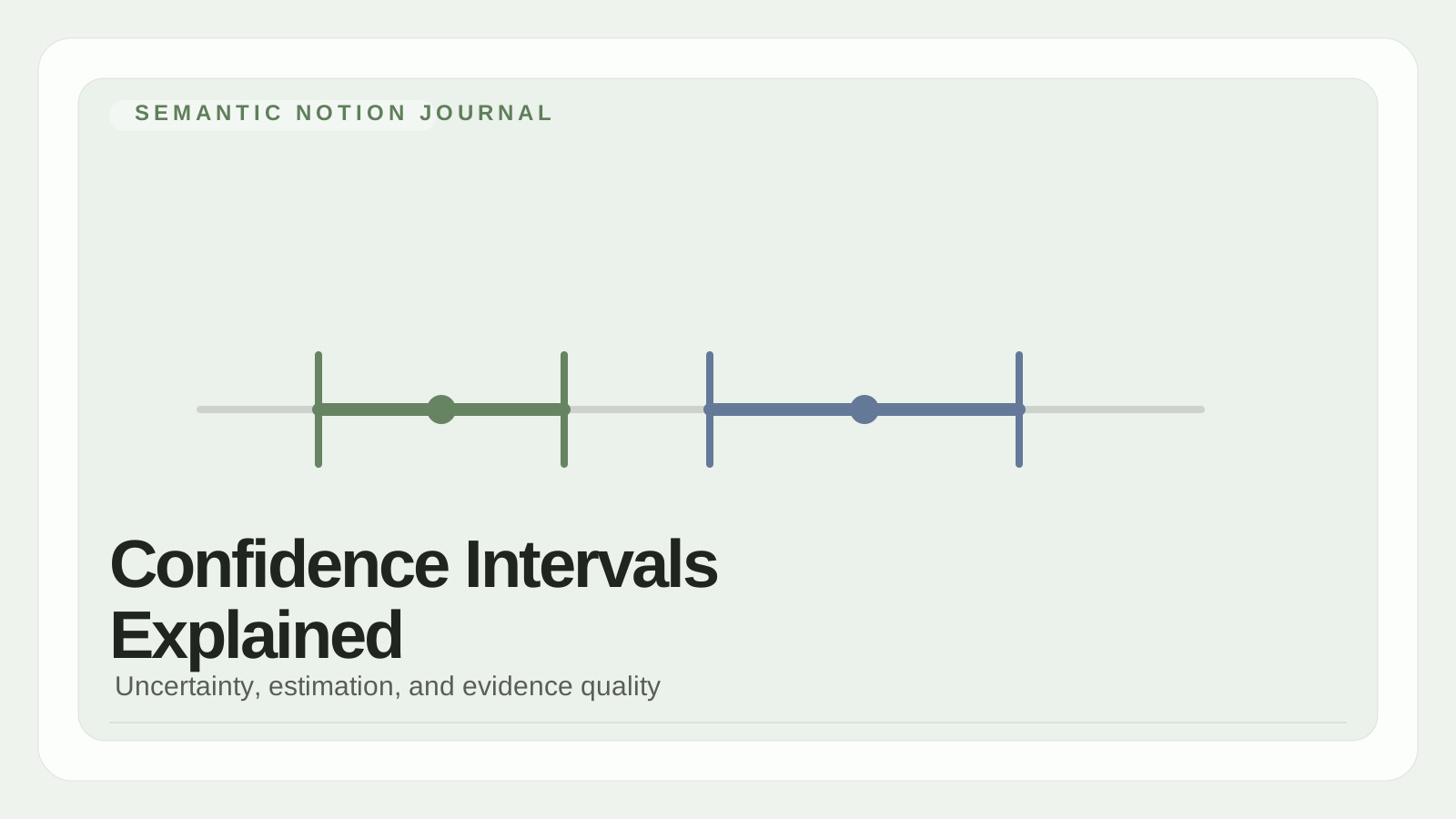
A confidence interval is a range produced by a statistical procedure that is meant to capture an unknown quantity with a specified long-run frequency. In plain language, it gives you a range of plausible values for an estimate while acknowledging sampling uncertainty.
The part people usually get wrong is what the confidence level means.
Why Point Estimates Are Not Enough
Suppose you estimate:
- average conversion rate
- model accuracy
- treatment effect
- customer lifetime value
A single number can be useful, but it can also be misleadingly precise.
If your estimate comes from a sample rather than the full population, there is uncertainty. Another reasonable sample could have produced a somewhat different estimate.
Confidence intervals exist to make that uncertainty visible.
The Core Intuition
Instead of saying:
"The conversion rate is 12.4%"
you may say:
"The conversion rate is estimated at 12.4%, with a confidence interval from 11.6% to 13.2%"
That interval does not eliminate uncertainty. It expresses it.
The central idea is that estimation should report not only a best guess, but also how much wiggle room the data leaves around that guess.
What the Confidence Level Actually Means
This is the most misunderstood part.
A 95% confidence interval does not literally mean:
"There is a 95% probability that the true value lies inside this specific interval."
Under the classical interpretation, the true value is fixed and the interval either contains it or does not.
The 95% refers to the procedure:
if you repeated the sampling and interval-construction process many times, about 95% of those intervals would contain the true value.
That is why confidence intervals are really about repeated sampling behavior.
Why This Feels Counterintuitive
People naturally want to interpret a confidence interval as a direct probability statement about the unknown value.
That instinct is understandable, but it is not the standard frequentist meaning.
The right mental model is:
- the data sample could have varied
- the interval is one outcome of a repeatable procedure
- the confidence level describes the long-run success rate of that procedure
You do not need to love the terminology, but you do need to interpret it correctly.
What Makes Confidence Intervals Wider or Narrower
Intervals tend to become wider when:
- sample sizes are smaller
- measurements are noisier
- estimates are more variable
Intervals tend to become narrower when:
- sample sizes are larger
- noise is lower
- the estimate is more stable
This is why interval width often gives a useful practical sense of how much precision the data actually supports.
Why Confidence Intervals Matter in Data Science
Confidence intervals matter because data science is full of estimated quantities.
Examples include:
- A/B test effects
- forecast accuracy
- model performance metrics
- conversion rate estimates
- average user behavior summaries
If you report only point estimates, you can easily create false certainty. Intervals force the conversation back toward evidence and uncertainty.
Confidence Intervals and Model Evaluation
This matters more than people often realize.
Suppose Model A has 84.2% accuracy and Model B has 84.8% accuracy.
That difference may look meaningful, but if uncertainty around both estimates is substantial, the apparent gap may not justify a strong conclusion.
Confidence intervals help you ask:
- is this difference stable?
- how much could sampling variation explain it?
- are we seeing signal or noise?
This is especially important in evaluation pipelines where teams are tempted to overreact to tiny metric changes.
Confidence Intervals Do Not Prove Causality
An interval around an estimate tells you about uncertainty in that estimate. It does not automatically validate the underlying causal story.
That is why this topic connects naturally to correlation vs causation in data science.
You can estimate a quantity precisely and still be estimating the wrong conceptual thing. Statistical precision does not rescue a bad causal interpretation.
Overlap Is Not the Whole Story
People often compare intervals visually and ask whether they overlap.
That can be a helpful rough check, but it is not a complete decision rule in every setting. Proper comparison depends on the structure of the problem, the estimators involved, and the hypothesis being tested.
So interval overlap is a useful intuition, not a universal theorem for all comparisons.
Why This Matters for Communication
Confidence intervals improve technical communication because they force analysts to show both estimate and uncertainty.
That often leads to better decisions:
- less overreaction to small metric differences
- more realistic discussion of sample limitations
- stronger understanding of what the data can actually support
In practice, that is one of their biggest benefits.
Why This Matters in Product Systems
Confidence intervals become especially important when teams are comparing experiments, model variants, business metrics, or quality improvements that look meaningful at first glance but may still be explained by noise.
That is a product decision issue, not just a statistical one. If a team overreads a weak metric change, it can prioritize the wrong experiment, ship the wrong model, or make a strategy decision on unstable evidence.
If your team is trying to turn model evaluation or experimentation into a reliable production decision process, QuirkyBit's guide on building an AI feature into an existing product is the practical implementation-side companion.
Common Misunderstandings
Does a 95% confidence interval mean there is a 95% chance the true value is inside it?
Not in the standard frequentist interpretation. The 95% refers to the long-run behavior of the interval-building procedure.
Are narrow intervals always good?
Not automatically. Narrow intervals can still be misleading if the underlying assumptions or sampling process are flawed.
Do confidence intervals solve causal questions?
No. They quantify uncertainty around an estimate, but they do not by themselves establish causal validity.
FAQ
What is a confidence interval in simple terms?
It is a range of plausible values for an unknown quantity, produced by a statistical procedure that reflects sampling uncertainty.
Why are confidence intervals useful?
Because they show how much uncertainty surrounds an estimate instead of pretending a sample-based number is exact.
What does 95% confidence mean?
It means that if the sampling-and-interval procedure were repeated many times, about 95% of the resulting intervals would contain the true value.
Why should data scientists care about confidence intervals?
Because model evaluation, experiments, and operational metrics often involve estimated quantities that should not be reported without uncertainty.