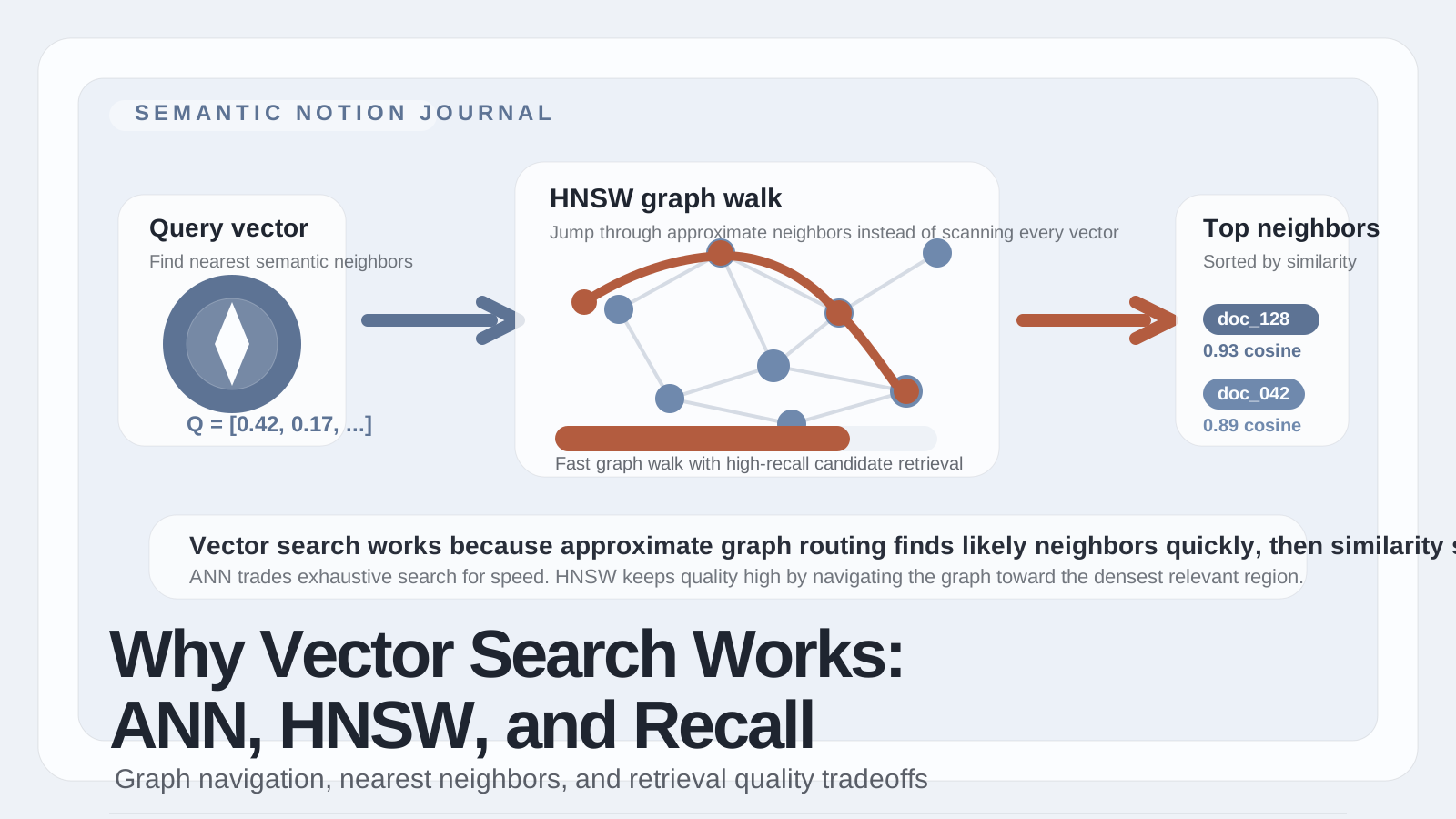
Vector search works because embeddings place similar items near each other in a high-dimensional space, and nearest-neighbor retrieval can exploit that geometry to find relevant results. The engineering challenge is that exact search becomes expensive at scale, so practical systems use approximate nearest neighbor methods such as HNSW to retrieve very good matches quickly rather than perfect matches slowly.
That tradeoff is why vector search is both a mathematical idea and an infrastructure problem.
Start with the Geometry
In vector search, documents, products, images, or chunks of text are represented as vectors.
The assumption is that the embedding space is useful:
- nearby vectors tend to represent related items
- distant vectors tend to represent less related items
If you want the full intuition behind that geometry, the foundation is what embeddings are in machine learning.
Once you have vectors, the retrieval problem becomes:
"Given this query vector, which stored vectors are closest?"
That is the core of vector search.
Why Similarity Metrics Matter
Closeness in vector space must be defined somehow.
Common choices include:
- cosine similarity
- dot product
- Euclidean distance
These do not always behave identically. The right choice depends on whether direction, magnitude, or both should matter. That is why cosine similarity vs dot product vs Euclidean distance is not a side topic. It directly affects what "nearest" means in retrieval.
Brute-Force Search Is the Exact Baseline
The simplest way to perform vector search is brute force.
For each query:
- compare it with every stored vector
- compute similarity or distance
- rank all candidates
- return the top results
This gives exact nearest neighbors. It is conceptually clean and often useful as a baseline.
The problem is cost.
If you have millions of vectors, exact comparison against every one of them becomes expensive in latency and compute, especially when you need fast interactive retrieval.
Why High Dimensionality Makes Retrieval Harder
Vector search systems usually operate in high-dimensional spaces.
That makes brute-force retrieval more expensive, and it also means neighborhoods can behave in unintuitive ways. These effects are related to the broader curse of dimensionality.
The point is not that vector search becomes impossible. The point is that naive exact nearest-neighbor search becomes increasingly costly as the dataset and dimensionality grow.
That is the problem approximate methods are trying to solve.
What Approximate Nearest Neighbor Search Means
Approximate nearest neighbor search, often shortened to ANN, relaxes the exactness requirement.
Instead of asking:
"Can we always find the mathematically exact nearest neighbors?"
it asks:
"Can we find neighbors that are extremely good, extremely quickly?"
That is usually the right engineering question.
In many real systems, retrieving the exact top result is less important than retrieving highly relevant results within a tight latency budget.
Why Approximation Is Usually Worth It
Suppose exact search gives you the perfect top 10 results, but takes too long for the product.
An approximate method may return 9 or 10 of those same results much faster. In practice, that can be the better system because users and downstream models care about response quality under realistic latency constraints.
This is why ANN is not a hack. It is a deliberate trade:
- give up some exactness
- gain major speed and scale advantages
The retrieval system becomes useful not by being theoretically perfect, but by being operationally strong.
What HNSW Is Trying to Do
HNSW stands for Hierarchical Navigable Small World graphs.
The name sounds more intimidating than the core intuition.
HNSW organizes vectors into a graph structure that makes search navigation efficient. Instead of comparing the query to every vector, the system moves through a graph by following promising neighbors.
The hierarchy helps the search begin with coarse navigation and then refine toward better local candidates.
So the rough intuition is:
- upper layers help the system move quickly across the space
- lower layers help it search more precisely in promising regions
This is why HNSW often performs so well in modern vector-search systems.
Why Graph Navigation Helps
Imagine searching for a location in a city.
You usually do not inspect every possible street from scratch. You move through larger roads first, get into the right area, and then refine locally.
HNSW uses a similar spirit in vector space.
The search process tries to move toward better candidates step by step, using graph connectivity to avoid exhaustive comparison against everything.
That makes search much faster while often keeping retrieval quality high.
HNSW Is About Search Efficiency, Not Semantic Understanding
This distinction matters.
HNSW does not create semantic meaning. The embedding model does that part by placing related items near one another.
HNSW is the retrieval machinery that helps the system navigate that learned space efficiently.
So the stack is roughly:
- embeddings create useful geometry
- similarity metrics define closeness
- ANN indexes such as HNSW make search practical at scale
- vector databases operationalize storage and retrieval
That is why vector search sits naturally beside what are vector databases, not in opposition to it.
Why Recall Is the Right Quality Lens
When using approximate search, you need a way to measure how much retrieval quality you gave up.
Recall is one of the most useful metrics for that.
In this context, recall usually asks:
"How many of the true relevant or exact-nearest results did the approximate method recover?"
If exact search would have returned 10 ideal neighbors and the approximate system returns 9 of them, recall is high.
This makes recall a natural way to evaluate ANN quality because it compares approximation against a stronger reference.
Why Speed and Recall Trade Off
Most ANN systems let you tune the balance between search speed and retrieval quality.
If you search more aggressively:
- latency may rise
- recall may improve
If you search more cheaply:
- latency may fall
- recall may drop
This is one reason vector-search tuning is not only a modeling task. It is a systems-design task. The right setting depends on product constraints and downstream tolerance for retrieval loss.
Why This Matters for RAG and Retrieval Systems
Modern retrieval-augmented generation pipelines rely on vector search to fetch useful context for language models.
In those systems, retrieval quality shapes:
- what context the model sees
- which documents get cited
- how grounded or hallucination-prone the response becomes
That means ANN quality is not an isolated backend concern. It can directly influence answer quality in user-facing AI systems.
Exact Search Still Has a Place
Approximate search is common, but exact search still makes sense in some settings:
- smaller datasets
- offline evaluation
- high-precision benchmarking
- scenarios where latency constraints are mild
Exact search is especially important as the reference point against which ANN methods are judged.
So the real comparison is not "exact versus approximate forever." It is "which retrieval mode is appropriate for this scale and latency target?"
From Retrieval Theory to Product Systems
Vector search becomes product work when teams have to balance retrieval quality, latency, permissions, cost, and grounded answer quality at the same time. ANN and HNSW are not just backend jargon. They influence whether the right documents are retrieved quickly enough for a user-facing workflow.
That is especially important in RAG systems, support copilots, internal knowledge tools, and recommendation surfaces where weak retrieval quality quietly degrades the whole experience.
If your team is moving from retrieval concepts into implementation choices, QuirkyBit's guide on how to build an AI feature into an existing product covers the broader production layer around evaluation, architecture, and rollout.
Why Vector Search Works in One Sentence
Vector search works because learned embeddings create meaningful geometry, and efficient nearest-neighbor methods exploit that geometry to retrieve relevant items without reading the entire database one row at a time.
That is the real synthesis:
- representation learning gives you the space
- similarity metrics define closeness
- ANN indexes make the search fast enough to use
Common Misunderstandings
Is vector search just keyword search with a new name?
No. Keyword search relies on lexical overlap, while vector search relies on geometric similarity between learned representations.
Does ANN mean the results are unreliable?
Not necessarily. ANN often returns very strong results with far better latency than exact search. The point is to manage the speed-quality tradeoff intelligently.
Is HNSW the embedding model?
No. HNSW is an indexing and search structure. The embedding model produces the vectors being searched.
FAQ
What is vector search in simple terms?
It is retrieval based on finding vectors that are closest to a query vector in an embedding space.
Why do systems use ANN instead of exact search?
Because exact nearest-neighbor search becomes too expensive at large scale, while ANN can return highly relevant results much faster.
What is HNSW intuitively?
It is a graph-based indexing method that helps search move quickly through vector space toward promising candidates instead of comparing against everything.
Why is recall important in vector search?
Because it helps measure how many of the best or exact-nearest results an approximate search method successfully recovers.