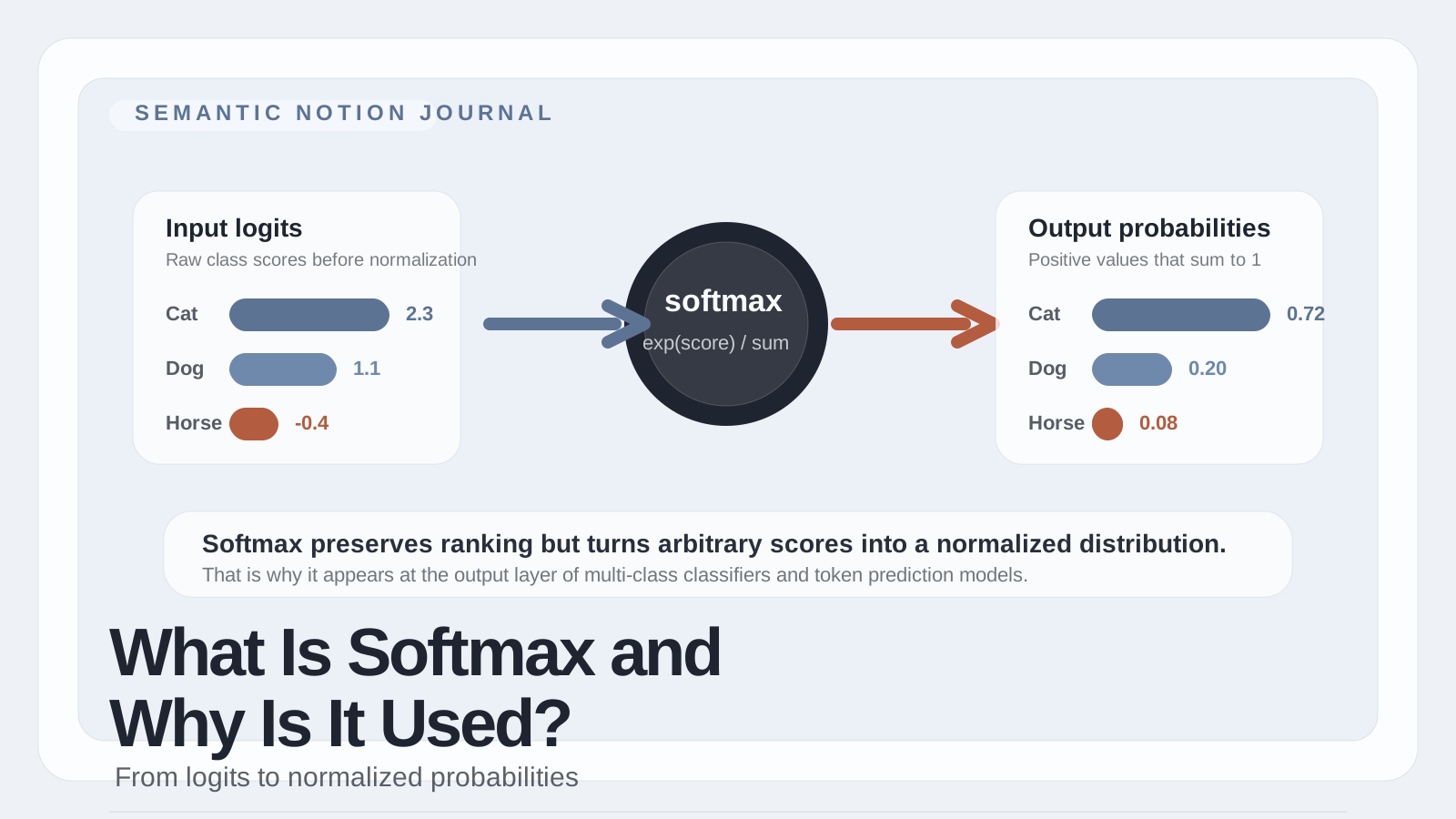
Softmax is a function that turns a list of raw scores into a normalized distribution of positive values that sum to 1. In practice, that makes it useful whenever a model needs to convert internal scores into probability-like weights, especially in classification and attention.
Softmax matters because many machine learning systems do not make decisions directly from labels. They first compute scores, then need a principled way to compare, normalize, and interpret those scores.
Start with Logits, Not Probabilities
Before softmax is applied, a model often outputs raw values called logits.
These logits are not probabilities. They can be:
- positive
- negative
- large
- small
- not constrained to sum to 1
Suppose a classifier produces:
- cat:
2.3 - dog:
1.1 - horse:
-0.4
This tells us the model prefers cat, but it does not yet give a normalized distribution. Softmax takes those scores and converts them into comparable probability-like values.
The Core Idea
Softmax does two important things:
- it makes all outputs positive
- it normalizes them so they sum to 1
That gives us something much easier to interpret.
Instead of raw internal scores, we can talk about relative preference across classes or options. The largest softmax value still corresponds to the most preferred choice, but now the entire output behaves like a distribution.
Why Exponentiation Shows Up
One thing that confuses people is the exponential step inside softmax.
Why not just divide the logits by their sum?
Because logits can be negative, and because we want stronger preferences to matter more sharply. Exponentiation does two useful jobs:
- it ensures outputs become positive
- it amplifies relative differences between scores
If one class has a logit slightly larger than another, exponentiation makes that preference more visible. If a class is much larger, the resulting softmax weight becomes much more dominant.
That behavior is often desirable because a model's ranking should influence how strongly it commits.
Softmax Is About Relative Scores
Softmax does not care about one score in isolation. It cares about how the scores compare with each other.
If all logits increase by the same amount, the resulting softmax distribution stays the same. That tells you something important:
softmax is driven by relative differences, not absolute offsets.
This is one reason it fits well with classification and attention. In both settings, the model is often asking:
"Which option should receive more weight relative to the others?"
Why Softmax Is Used in Classification
In multiclass classification, the model often needs to distribute belief across several mutually exclusive classes.
Examples:
- cat vs dog vs horse
- spam vs promotion vs primary
- positive vs neutral vs negative
Softmax turns logits into a distribution over those classes. That makes it natural to combine with cross-entropy loss, which punishes the model when it assigns too little probability to the correct class.
This pairing is common because it is both conceptually clean and mathematically convenient for gradient-based learning.
Softmax and Cross-Entropy Work Together
The relationship is worth making explicit.
Softmax produces the predicted distribution.
Cross-entropy then measures how far that predicted distribution is from the target.
So the training loop effectively becomes:
- compute logits
- convert logits into probabilities with softmax
- compare those probabilities with the correct answer using cross-entropy
- update the model through backpropagation
If you want a deeper view of how those updates move through a network, see backpropagation explained without hand-waving.
Why Softmax Appears in Attention
Softmax is not only for classification.
In attention mechanisms, the model computes compatibility scores between tokens. Those raw scores tell the model how relevant one token is to another, but they still need to be turned into usable weights.
That is where softmax enters.
It converts compatibility scores into normalized attention weights, so the model can form a weighted combination of value vectors.
In other words:
- raw attention scores say how compatible tokens are
- softmax turns those scores into a weighting distribution
- the model uses that distribution to mix contextual information
This is why softmax shows up inside attention in transformers, not just at the output layer of a classifier.
What Softmax Does Not Mean
A softmax distribution often looks like a probability distribution, but interpretation requires care.
The model may output:
- class A: 0.92
- class B: 0.05
- class C: 0.03
That does not automatically mean the model is well calibrated. It only means the model strongly prefers class A relative to the other options.
A model can be highly accurate on rankings while still being poorly calibrated about uncertainty. That distinction becomes important when thinking about calibration vs accuracy in machine learning.
Temperature Changes the Shape
Temperature is a scaling factor applied to logits before softmax.
Lower temperature makes the distribution sharper:
- the top option becomes more dominant
- the model looks more confident
Higher temperature makes the distribution flatter:
- probability mass spreads out more
- the model looks less committed
This matters in generation systems because temperature changes how deterministic or diverse the output becomes.
So temperature is not magic. It changes how strongly softmax emphasizes score differences.
Why Softmax Remains So Useful
Softmax survives in many systems because it solves a simple but recurring problem well:
how do we turn arbitrary scores into normalized relative weights?
That problem appears in:
- multiclass classification
- language modeling
- token prediction
- attention mechanisms
- ranking-like internal decisions
Whenever a model needs to distribute weight across competing options, softmax is a natural candidate.
Why This Matters in Product Systems
Softmax is easy to dismiss as a formula detail, but it directly affects how model scores become usable outputs. That matters in classification systems, language-model token selection, retrieval re-ranking, and attention-based behavior inside modern AI products.
Understanding softmax helps teams reason about confidence-like outputs, temperature effects, and why a model can look decisive without actually being trustworthy. Those distinctions become important when outputs are shown to users, sent into downstream systems, or used to automate workflow steps.
If you are evaluating whether those model behaviors are strong enough for production, QuirkyBit's guide on how to choose an AI feature for an existing product is the practical implementation-side companion.
Common Misunderstandings
Is softmax the same as a probability guarantee?
No. It produces probability-like outputs, but that does not guarantee the model's confidence is well calibrated.
Is softmax only used at the final layer of a network?
No. It also appears inside attention mechanisms and other places where normalized weights are needed.
Why not just choose the largest logit and skip softmax?
You can choose the top class that way at inference time, but training and weighted reasoning often need the full normalized distribution.
FAQ
What is softmax in simple terms?
It is a function that turns raw scores into positive weights that sum to 1.
Why is softmax used in classification?
Because it converts class logits into a distribution that can be compared against the correct class using cross-entropy loss.
Why is softmax used in attention?
Because it turns attention scores into normalized weights for mixing information across tokens.
What does temperature do in softmax?
It changes how sharp or flat the output distribution becomes by scaling the logits before normalization.